May 2026
What’s a middle manager anyways?
We’re starting to see the first corrections in tech layoffs: companies realizing they don’t need the same number of people doing the same kind of work when some employees can now use AI.
This is affecting middle managers in a way that I believe they’re not used to: facing a threat to their entire profession.
But that raises the question: What is a middle manager, anyways?
The answer matters because we tend to use the same title for two very different jobs.
One is moving information around. Information Middle Managers spend their days full of meetings and focus sessions, turning strategy into plans. Then turning plans into meetings. Turning meetings into updates. Turning updates into dashboards. Turning dashboards back into strategy.
The other job is judgment. Judgment Middle Managers know where work gets stuck. They know when a person needs coaching, instead of another process. They know when a team misunderstands the goal. They also know which problems are real and which are just noise.
AI is bad at the second kind of work. But it’s getting very good at the first.
The hourglass org
That distinction explains why the future of middle management seems contradictory. It’s both shrinking and becoming more important, depending on which part you mean.
A recent paper described the AI-first organization as less of a pyramid and more of an hourglass.
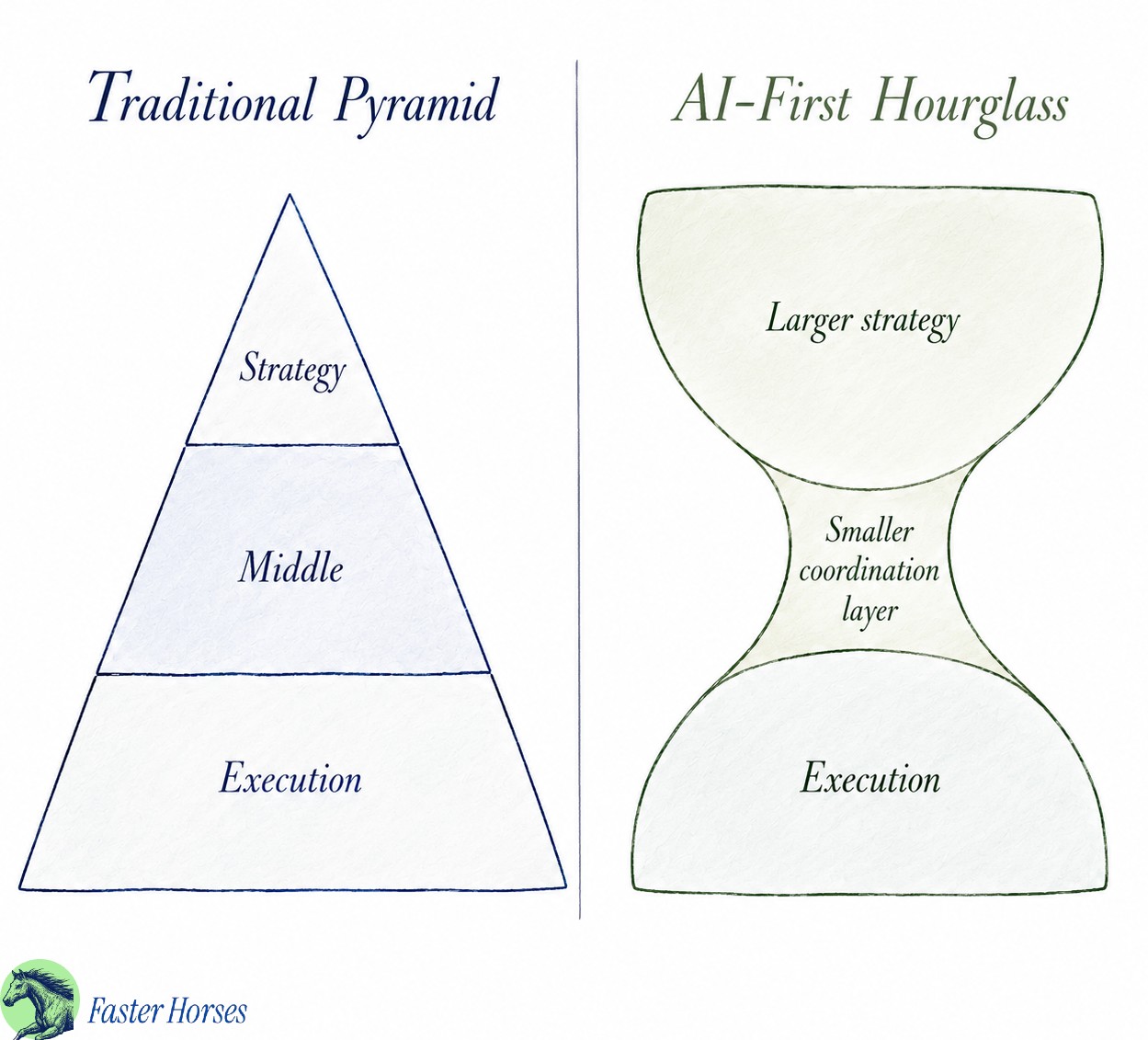 The pyramid vs the Hourglass
The old organization is a pyramid: a large execution layer at the bottom, a small strategy layer at the top, and a thick middle layer between them. That middle layer exists to translate strategy downward and reality upward.
But the hourglass model expands the execution layer, and drastically narrows the middle. Some managers disappear. Some move upward into a larger strategy layer.
That part feels right to me. Because a lot of middle management is not management at all. It is just organizational duct tape.
Information Middle Managers exist because companies are bad at efficiently transmitting context. Strategy gets compressed at the top, reimagined or distorted in the middle, and misunderstood at the bottom. So the company invents processes to repair the damage: alignment meetings, weekly syncs, planning docs, retros, status updates, quarterly planning.
AI makes all of that visible, and eventually obsolete.
In an AI-first organization, strategy does not need to pass through as many human relay stations. The strategy layer can send clearer context down. The execution layer can send raw signals up. AI can summarize, translate, route, and compare those signals continuously.
But to be clear: this does not eliminate the need for managers. It eliminates the need for managers whose main job is to make up for bad system design.
AI-first middle managers
The middle manager of the future is not going to be a better coordinator. That job is dying. AI will handle information coordination.
The middle manager of the future is a designer of work. Someone who will build the systems through which strategy becomes execution without needing a human information-mover in the middle. Someone who decides what should be automated, what should be escalated, what should be ignored, and what still requires a good amount of taste.
That means the question for middle managers is not “how do I use AI to do my current job faster?” That’s actually the trap. The question is: “Which parts of my job only exist because the organization is badly designed?”
Because those are the parts AI will expose first.
And for leadership, the question is not “How do we train middle managers to improve their existing processes?” Instead, it’s: “How do we get them to create a new operating model?”
The best middle managers will become more strategic, not because they sit closer to executives, but because they understand the details of execution better than anyone else. They will know where context breaks, where decisions stall, where teams misunderstand each other, where AI can replace processes, and where human judgment still matters.
Mediocre middle managers will try to protect the old layer. They will use AI to write better status updates, cleaner planning docs, and faster meeting summaries. The great ones will ask why those things existed in the first place.
That’s the real threat to middle management. Not that AI will do their job. But that AI will reveal how much of the job was merely compensating a broken system.